


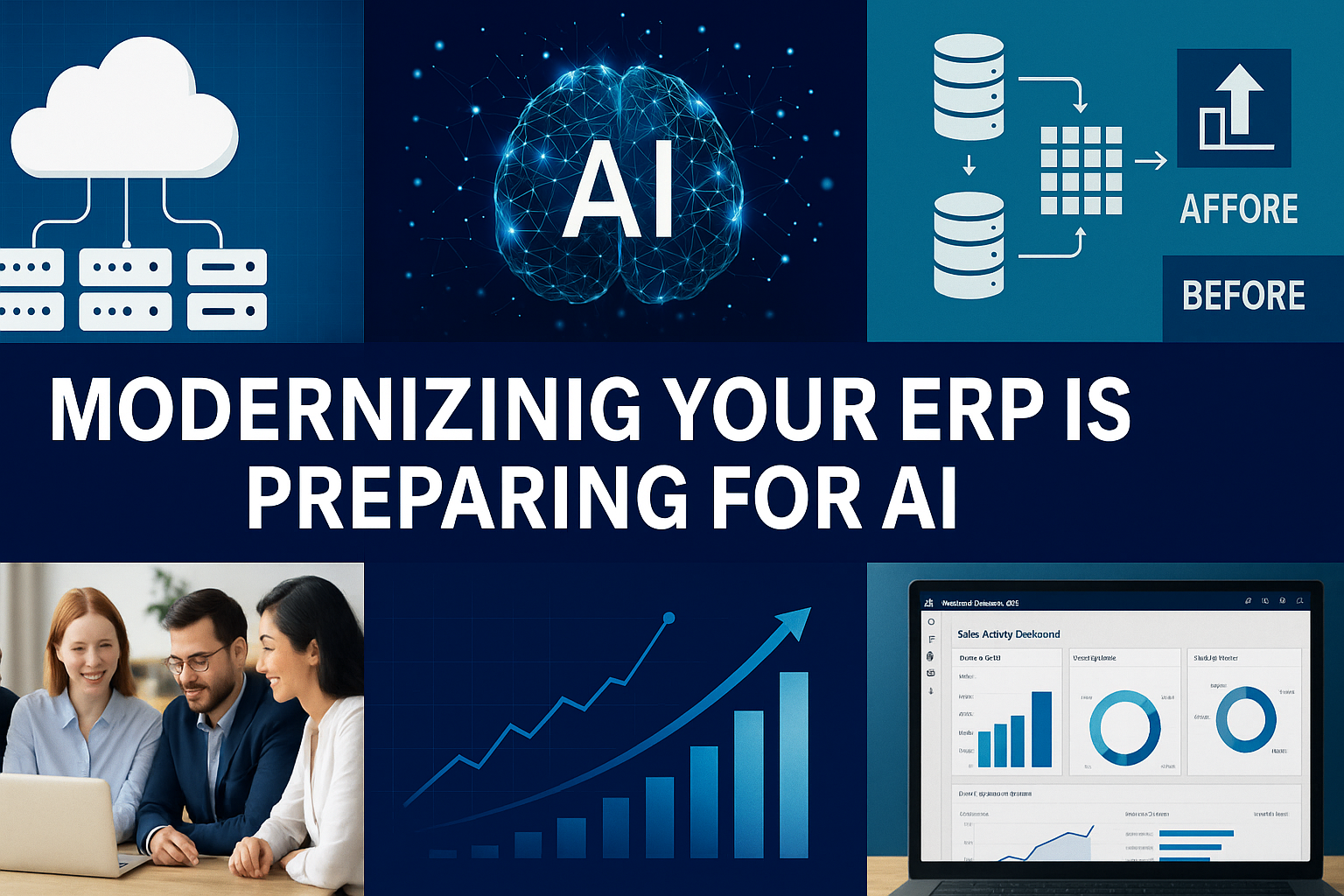
Enterprise resource planning (ERP) systems have long been the backbone of companies with the value being integrated finance, inventory, supply chain, and customer management. Conversations with C level leaders have revealed an understanding that legacy ERP systems are barriers rather than enablers. AI is generally cloud-first because of the scalability and capability, so being stuck on-prem is a major hurdle to productivity. Modernizing your ERP isn’t just an IT upgrade—it’s a strategic step toward the leveraging of AI across your organization!
Legacy ERP Systems are Anchors in a Data-Driven World
The markets require us to stay competitive and yet older ERPs are often out of support, dependent on aging hardware, and unable to take advantage of AI. More critically, they lack the foundation necessary to support artificial intelligence—such as scalable cloud infrastructure, structured data pipelines, and built-in machine learning tools.
These technical limitations translate directly into missed business opportunities, increased rigidity, and decreased efficiency. The challenge is that your competitors are probably already adopting AI with a modern architecture.
Clean Data is Foundational
Data cleanup and governance never sound attractive! Yet AI requires data and history. For predictive models and intelligent automation to work, they require clean, structured, and real-time information. This is a major driver for companies looking to modernize ERPs, i.e. Dynamics 365, and also adopt Microsoft Fabric.
Microsoft Dynamics 365, solves this problem by consolidating information into a single, cloud-based platform and bringing built-in AI features. If you’re serious about AI, the first step is ensuring your data is AI-ready—and that starts with modern ERP.
Dynamics 365 is an AI-First ERP
Microsoft Dynamics 365 stands out as a leader in the movement toward AI-first ERP systems. In fact Microsoft has started to use the term “AI ERP.” Microsoft re-platformed the old Dynamics AX when it moved to the cloud (Azure) in 2017. Dynamics 365 is already optimized and cloud-native. I say cloud-native because it runs as .NET in modern containers using Azure SQL High Availability groups and can scale up and down automatically. It can run materials resource planning (MRP) in a matter of minutes, compared to on-prem systems which commonly require hours to replan the organization.
You should familiarize yourself with the many AI features inside of Dynamics 365.
One example, Dynamics 365 provides cash flow forecasting so you can reduce reliance on your revolving credit line. Not only that, the AI features in Dynamics 365 are built-in and generally included at no additional cost; they’re available today and continually improving.
By adopting Dynamics 365, CIOs and CFOs aren’t just upgrading infrastructure—they’re unlocking a platform designed to adapt and scale with the business, driven by continuous AI innovation from Microsoft.
The Cloud is Where AI Lives and Grows
One of the most important reasons to modernize ERP in the cloud is that AI lives in the cloud. Cloud platforms offer the processing power, storage, and scale needed to support AI workloads. The cloud receives new AI updates first, well before you can run them on the edge, or on-prem.
On-prem ERP systems are inherently limited in their ability to run large-scale AI models, manage complex integrations, or take advantage of real-time analytics. Simply put, if you’re not in the cloud, you’re risking missing out.
AI in Action: What It Looks Like on the Ground
AI is not something that is just hype. I’m seeing many companies start teams and projects around AI. Here are a few high-impact use cases:
-
Inventory Optimization: Machine learning models analyze historical sales, lead times, and seasonal trends to forecast demand with greater accuracy—reducing excess stock and minimizing stockouts.
-
Automated Financial Processes: AI can streamline financial close, detect fraud, and automate invoice matching—freeing up teams to focus on strategic work.
-
Customer Service Automation: AI-powered chatbots and service agents handle routine inquiries, speeding up response times and improving customer satisfaction.
-
Predictive Maintenance: In manufacturing and distribution, machine data combined with ERP data can predict when machines are likely to fail, reducing downtime, and repair costs (and therefore disruption).
Readiness Starts With Strategy, People, and Budget
Transitioning to a modern, AI-ready ERP system isn’t just a technical decision—it’s a strategic one. Success requires alignment across three critical areas:
-
Business Objectives: Leaders must clearly define the outcomes they want to achieve—whether that’s improving margins, reducing cycle times, or enhancing customer experience—and align ERP and AI capabilities to support those goals. I encourage you to understand how an ERP modernization will further your P&L or Balance Sheet goals.
-
Employee Expectations: Change management is essential. Employees need to understand not only what’s changing, but why—and how AI will augment their work rather than replace them.
-
Budget and Investment: Modern ERP and AI investments must be seen not as costs, but as enablers of future efficiency and growth. ROI can often be realized within months through automation and improved decision-making.
Why You Need an AI-First ERP Strategy—Now
The shift toward AI-first software isn’t a passing trend. It’s a paradigm shift that’s reshaping how software is built, sold, and used. Dynamics 365 is already infusing AI into every layer and re-imagining every process. As these capabilities become more powerful, the gap between AI-enabled businesses and the rest will only widen.
Adopting an AI-first ERP like Dynamics 365 isn’t just future-proofing your technology stack—it’s future-proofing your business.
TL;DR
ERP modernization is more than a digital transformation milestone—it’s a critical step toward AI readiness. The cloud, structured data, and intelligent automation aren’t just nice-to-haves anymore; they’re foundational to competing in a rapidly changing market and more and more employees are expecting of us too.
[…] Original Post https://calafell.me/modernizing-your-erp-is-preparing-for-ai/ […]